
A birth certificate is not only a keepsake; it is a piece of paper with a job. After a fire, a burst pipe, or a flooded basement, the documents that prove who you are, what you own, and what you are owed are the ones you need first — and replacing any one of them means contacting the issuing agency or company and waiting, precisely when you can least afford to. Ready.gov puts the task plainly: after a disaster, having access to personal financial, insurance, medical and other records is crucial for starting the recovery process quickly and efficiently. The home plan has three moving parts — a short list of vital records, a protected place for the originals, and copies that absorb the daily wear — and each part is cheap to build this month and expensive to improvise later.
Which records count as vital
Start with a working definition: a vital record is a document that is hard to replace, slow to replace, or needed within days of an emergency. Ready.gov's preparedness guidance sorts them into groups that work well as an inventory checklist — household identification (photo IDs, birth certificates, Social Security cards, military service records), financial and legal documentation (housing payments, insurance policies, income records, tax statements), medical information (physician details, health insurance copies, immunization records, medication lists), and household contact information. The FEMA Emergency Financial First Aid Kit turns the same list into a fill-in form with a column for the date each item was added or updated, which is the quiet trick worth copying: an inventory that remembers when it was last true is the one you can trust under pressure.
Keep this list narrow. Correspondence, photographs, and keepsakes have their own preservation needs, and organizing family letters is a different task with different tools. Vital records earn special handling precisely because someone — an insurer, a school, a benefits office — will ask for them on a deadline.
Where the originals should live
FEMA's Emergency Financial First Aid Kit spreads protection across locations rather than betting everything on one box: paper copies of important documents belong in a fireproof and waterproof box or safe at home, in a bank safe deposit box, or with a trusted friend or relative, with electronic copies held in a password-protected file on a drive kept in that same home box or in secure off-site storage. One caveat the kit raises is easy to miss: if you use a bank safe deposit box for originals, ask your bank or check state rules about who can and cannot enter the box, because access can be restricted exactly when an estate or emergency makes the contents urgent.
Ready.gov's shorter version is Store important documents either in a safety deposit box, an external drive or on the cloud to make it easy to access during a disaster. Wherever the originals end up, the archival rules do not switch off. The National Archives' family-archives guidance keeps storage below 75 degrees Fahrenheit, holds relative humidity below 65 percent to prevent mold growth, warns that humidity below about 15 percent causes brittleness, and moves items out of damp basements, garages, and hot attics, away from pipes, windows, and known roof leaks. If those numbers describe a corner of your home only roughly, a humidity monitor turns a guess into a reading you can act on, and the room-by-room risk guide helps you pick the corner in the first place.
What a fire chest can and cannot promise
A fire chest is the home layer of the system, and its rating language deserves a slow read. Take one specific, well-documented example: the SentrySafe HD4100 water and fire safe file cabinet, whose manufacturer states it is UL Classified to protect your valuables in a fire for 1/2 hour up to 1550°F (843°C) and ETL Verified to protect your valuable items from flood damage up to 72 hours, in a format that holds up to 40 hanging folders. Read as claims, those sentences say three precise things: an independent lab classification for a half hour of fire exposure, a separate verified test for time-limited flood immersion, and a capacity figure. They are worth having — a chest like this is exactly what FEMA's kit means by a fireproof and waterproof box.
Read as limits, the same page says just as much. SentrySafe markets this chest for passports, check books and digital media, and it also says plainly that These safes provide basic protection and are not intended for tool attacks — the key lock organizes access; it is not a burglar alarm. And no rating on the page says anything about everyday humidity: a chest is a small, sealed box, so the room it lives in still sets the moisture conditions inside it. Put it on a shelf rather than the floor, as the National Archives advises for stored items generally, and let the room, not the chest, do the climate work.
The archival layer inside the box
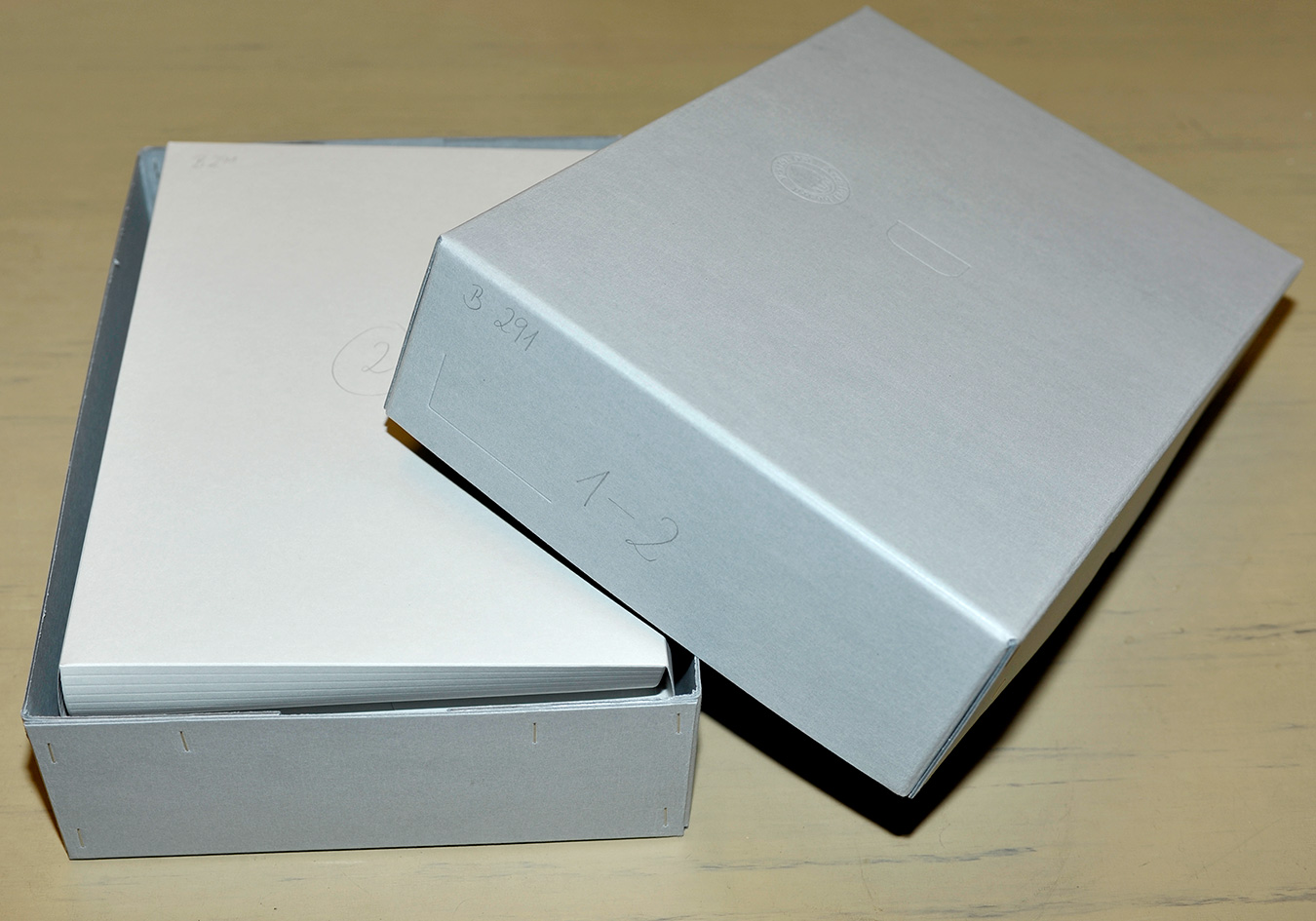
A rated chest protects against the rare catastrophe; the enclosure protects against the twenty years of ordinary. The National Archives lists what containers should do: be made of board or folder stock that is lignin-free and acid-free or buffered, pass the Photographic Activity Test if photographs are involved, and be sized so originals lay flat or upright without folding or bending, with a spacer board taking up slack and no overstuffing. For certificates and deeds, that usually means an oversized folder — never a fold — and for brittle, torn, or heavily handled sheets, NARA's advice is place each sheet in a polyester L-sleeve, one item per sleeve with every part of the text visible. The enclosure materials guide explains how to read the specifications before you buy; the chest does not exempt its contents from any of them.
Let copies carry the daily work
Every original you can keep out of daily circulation is an original that stays clean. Scanning or photographing the record set is the standard move, but digitization is a companion to paper, not a replacement: the National Archives tells families to Keep your originals after you digitize them, because digital files have their own preservation risks and can easily be lost, and gives the backup rule in one sentence: Three copies, stored on two different media, and one copy located off-site. FEMA's kit adds the practical detail that the drive living in your fire chest should hold those copies in a password-protected format.
Handle the originals gently even while copying them. The same NARA page warns that Automatic feed scanners are not suitable for fragile, weak, bent, or valuable papers; papers can jam and become torn in automatic feed scanners, and that a flatbed lid can crush a sheet that does not fit the glass. A certificate that will hang on a wall is a different case: the framing guide argues for displaying a marked copy and keeping the original in the dark — which is exactly the division of labor this whole system is built on.
A seasonal review
The FEMA kit schedules its own maintenance: revisit the file around tax season, when the clock changes, or near a birthday, and update it whenever life changes — a move, a new policy, a name, a beneficiary. A review that takes fifteen minutes checks four things: the inventory matches what is actually in the chest; the papers inside are dry and flat, with no smell or staining; the lid, latch, and gasket still close the way the rating assumes; and the contact list still reaches the people on it. If a review finds a problem, the emergency kit guide covers the first safe actions for water and other small incidents before they grow.
When home care stops being enough
Stop and change tools rather than technique in five situations. If records are already wet, do not force pages apart, peel stuck sheets, or apply heat; support them flat and move to the first-response steps in the emergency kit guide, and remember that freezing can be part of a professional salvage plan when drying cannot start promptly. If anything smells musty or shows staining, stop handling it and isolate it from dry material — suspected mold is a health question, not a cleaning question. If papers are charred, fused, or soaked after an actual fire or flood, leave the recovery to a document-drying service or a conservator. If a deed, certificate, or family document is on parchment, carries wax or embossed seals, or will not fold without cracking, give it an oversized folder and a conservator's opinion rather than pressure. And if a record's materials cannot be identified — laminated, coated, or plastic-something — do not add heat, solvents, or adhesives to the mystery; sleeve it, store it flat, and ask a professional before any treatment.
Sources and boundaries
This guide covers ordinary household paper records — identity documents, certificates, deeds, policies, and financial papers — in dry, intact condition. It is not a guide to buying a particular safe brand, to home security against burglary, to replacing lost government IDs, or to treating damaged documents; where a task crosses into salvage or treatment, it stops and points to professional help instead.
- Ready.gov: Financial Preparedness — why record access matters right after a disaster, the critical-document categories, and where copies belong.
- FEMA and Operation HOPE: Emergency Financial First Aid Kit (PDF) — the full toolkit with document checklists, the multiple-location copies model, the safe-deposit access caveat, and the update schedule.
- U.S. National Archives: Storing Family Papers and Photographs — temperature, humidity, and location limits; container and sleeve specifications.
- U.S. National Archives: Digitizing Family Papers and Photographs — keep the originals, the 3-2-1 backup rule, and scanner-handling cautions.
- SentrySafe: HD4100 water and fire safe file cabinet product page — one manufacturer's exact fire, water, capacity, and lock claims, quoted as an example of rating language and its limits.